Tuesday, November 16, 2010

Denver Art Museum

I’m glad we went on this field trip at the beginning of the year. It helped all of us get to know each other and it helped us get to know our way around downtown Denver. Learning where the Starbucks is was very nice, I definitely visited it a couple more times. I also felt more comfortable going downtown in my free time and taking a nice trip away from campus.
               The Denver Art Museum was beautiful on the inside and the outside. I loved the architecture; the use of windows and colors really added to the overall atmosphere. This trip made me realize how crucial light is. The lighting in the pictures and the lighting used to display the pictures is necessary to make the images pleasing to the eye. This trip added to my search for perfect lighting. I like doing studio photography because I can control the lighting, but I need more practice with natural light because it cannot be manipulated as much. Finding good lighting was one of my goals this year, but I did not meet it as much as I had wanted. This just means I need even more practice. I would like to try and continue my blog through-out the years and this should help me better distinguish good light from bad light. My search will continue.
               The exhibit was amazing. I liked learning about the different methods and ways to manipulate film. I never realized how liquids have such a large role in photography. Processing, developing, and printing all require liquids, but liquid can also be used as a way to distort film, add texture, or it can be the subject. Colored liquids are especially interesting. Liquids were used in several different ways within the exhibit.
This trip also made me focus on shadows because I was paying more attention to light. I discovered the intrigue of shadows, trying to determine how they are made is fascinating. Odd shapes can make very amusing and in my mind artistic shapes. I now enjoy creating shadows and I love how my eye is a little more trained and able to see them in everyday life. This, to me, is one of the main intrigues and purposes of photography. (Training the eye to see what others do not.) Like any other talent you must train yourself and your body above what is considered the normal.
This was one of my favorite pictures from the day because the lighting and shadows are great.


Sunday, November 14, 2010

Hylaea-Library Showcase

           
            Timothy Weaver is a new media artist who used to be a life scientist. Knowing this helps me understand why he took the pictures he did. I liked having the background knowledge because it made me less disturbed by the art. I was still a little confused even after I learned his background, but only because I think I have a wall-up against death. I do not know why, I just know that I do not like thinking about it.
 In the pamphlet the exhibit was explained to be “part ecological ghost story/ part zoological bibliography” and I believe the pamphlet was spot-on in that definition. These two aspects of the showcase are very different and I think this is why I had such mixed feelings and reactions to the artwork. I did not know if the display was to be seen morbidly, scientifically, or sorrowfully. I guess it might be better not to know so you can see and think what you want, but all the emotions I had were too many for me to handle.
Overall I saw the artwork in a sorrowful manner. All of these bird species had become extinct due to human-induced measures. This made me feel very sorry for the ways that humans have selfishly destroyed nature. The price the birds had to pay was not fair; they had done nothing but what nature intended them to do.
            On a more technical note, it was interesting to see all the different mediums through which Weaver projected his art. The video, prints, and rare book installation meshed nicely and really helped make the subject of the art stand out. I liked how the library acted as a little treasure you never knew when or where you would find the next component to Weaver’s art showing.
            It is nice to know that our university is able and willing to put on exhibits like Hylaea. I believe it is important for the university to keep us informed and cultured. I know this was not a huge art showcase, but the university did what it could and I appreciate it. It is the little things like this that make our university so unique.

Sunday, November 7, 2010

Eyes

These trees are so mysterious, seeing them always makes me wonder if trees are more alive then we think they are. These trees are also gorgeous...they are so different! I wonder what causes these trees to have such different bark. I also wonder why they make eye shapes and not other shapes. I wonder if you could genetically program a tree to make shapes like hearts or other shapes. It would be really could if you could!

Beautiful DU

I was walking back from my ten o'clock , Friday math quiz when I randomly notice how beautiful my surroundings were. The colors and architecture were stunning. I love how fall does this and I love that we have a campus that shows-off fall's amazing powers. I like personifying fall in this way. Interesting fact: I think the depth of field in this picture makes our campus look bigger than it actually is.

Sally Mann

(This is an eerie picture...I wonder what her children think of this picture. I do not have problems with the pictures Sally Mann took of her children, but I understand why others may question. I question a little, but It seems like her children turned out fine so who am I to judge?)
           Sally Mann is described as being able to see what others do not. She can find and make art out of ordinary objects and happenings. This is a true gift. She has been blessed with an amazing gift, a loving and happy filled childhood, a nice husband, three great children, and a wonderful career. I hope she appreciates what she has been given, but I understand that she also had to work and strive to deserve all the wonderful things that have happened to her. Even the bad that she had to experience, like her father’s death, influenced her work in a positive way. I liked learning about her process, her way of thinking, and what kind of person she is. By the end of the movie I felt like I knew her and I liked what I saw.
            I liked how she described that landscape has magic; she just needs to find it.  I also like how she described how she welcomed the angel of uncertainty. In my high school photography we sometimes made what we called trash art, which consisted of making a print that was not quite perfect then throwing it into the trash can in the dark room. In a few hours or minutes we retrieved our prints, but they had been transformed by the chemicals that were thrown on them while in the trash can; sometimes the prints were altered or “ruined” in just the right way that they became amazing works of art. I like how she admitted that some of her prints become amazing having nothing to do with her touch. She is giving credit where credit is due; I like this.
            When her project on death did not get to be shown at Pace I felt for Sally, but she should have thought about the situation more clearly. It seemed like she needed others to like and appreciate her work, but did she spend all her time working on the photos for herself or for others? I hope she did it for herself instead of others because she will never be able to control how others view her work, her satisfaction should be enough, but I understand needing to be liked and appreciated by others…it is due to our own insecurity.

Wednesday, November 3, 2010

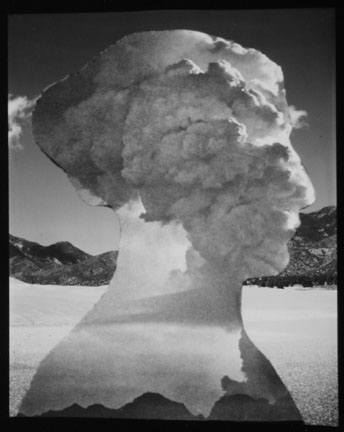
Thunderhead, Ruth Thorne-Thomsen #2

      I am amazed by the talent Ruth Thorne-Thomsen has in order to put together a picture like she did without the modern day digital photography and programs like Photoshop. It must have taken her a lot of time in order to put it together. A picture like this takes determination, she must have really loved what she did or else she would not have invested the time necessary to produce such an outcome. I praise her dedication. It took a lot of learning to make a photograph like this. For example Thomsen received a BFA in painting from Southern Illinois University, Carbondale, a BA in photography from Columbia College Chicago, and an MFA in photography from The School of The Art Institute of Chicago. She worked hard in order to make extraordinary pictures like “Thunderhead.”
“Thunderhead” also makes you think when you look at it. I found myself asking…why make a picture like this, but when looking at it further I realized the deeper meaning. “Thunderhead” juxtaposes what is going on inside the human mind to what is happening in nature. The human mind is cloudy, foggy, confusing. So many thoughts take place at once inside the human mind. The mind changes thoughts feelings and emotions quickly like a storm. The human mind can also be loud like a storm.  There is juxtaposition because the head is surrounded by calm serine nature. The landscape/nature surrounding he woman’s head is the opposite of the mind. Nature is peaceful and unchanging. I think the head/mind wants to be like nature. Nature is praised in this picture…if the craziness of the mind was being praised a storm would not have represented the mind, because a storm represents a bad situation, not a good one. Nature is praised because it looks beautiful versus dark and scary like the head’s mind.
I wonder why a woman’s head was chosen versus a man’s. Was this part of Thomsen’s plan or does it play no role in the overall concept of the photograph? I also wonder why Thomsen wanted to portray this juxtaposition in the first place. Was Thomsen feeling this way? (Confused on the inside and wanting to be like nature.)   

Thunderhead, Ruth Thorne-Thomsen #1